The Great Penny Mess
The last penny has been produced, but there is confusion about the path forward.
Dec 04, 2025 | 7 min read
By Jeff Lenard
(Updated from original June 5, 2025, post.)
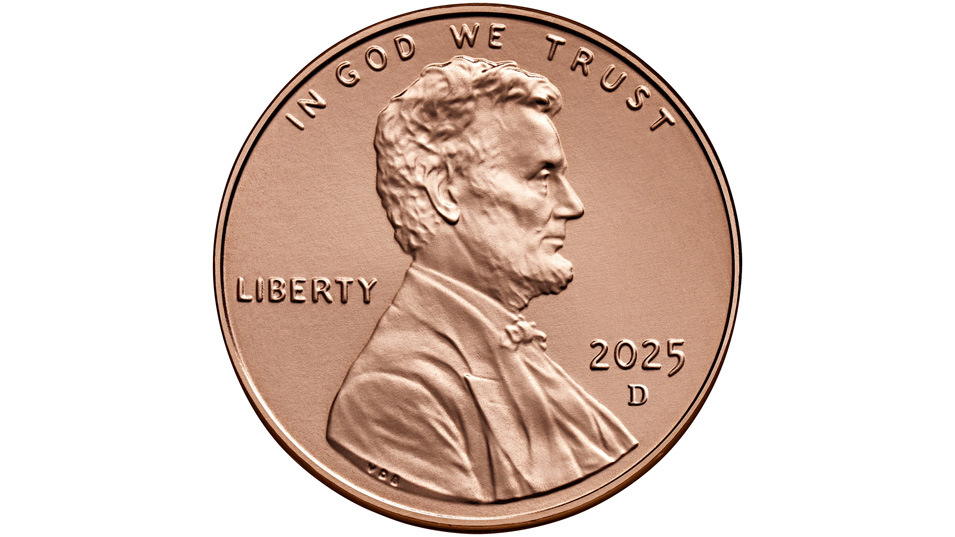
The U.S. penny has a rich history and has been beloved by coin collectors, fans of Abraham Lincoln (since 1909) and lovers of nostalgia since the U.S. Mint produced the first penny in 1792. The problem is that too many other people over the past few decades have found them to be a nuisance, and an expensive one: It costs 3.69 cents to make a one-cent coin.
In November 2025, the U.S. Treasury printed the last few ceremonial pennies. The once unloved penny has become a popular subject now that shortages have intensified. In 2024, 3 billion pennies were produced—an average of 10 pennies for every citizen, on top of another 200 billion already in circulation. The problem is that pennies don’t “circulate.” About 7 of every 10 pennies given in change don’t recirculate, likely ending up in coin jars or someplace else. The lack of new coins produced this year has gradually created a coin shortage, with tens of thousands of retailers finding it difficult—or impossible—to get enough pennies for change.
Right now, retailers are faced with three bad options if they aren’t able to obtain a sufficient supply of pennies:
1. Round down all cash transactions in the customers’ favor. On average, a cash transaction requires 2 pennies in change. (There are five possible change transactions, with 0 cents, 1 cent, 2 cents, 3 cents or 4 cents in change: 10/5 = 2.)
Each day, convenience stores conduct approximately 160 million transactions, of which about 125 million are inside the store. Roughly 50% of these transactions are by cash, meaning there are about 62.5 million cash transactions a day in the industry. Two cents would cost the industry roughly $1.25 million every day. Also, convenience stores have much lower basket sizes—typically around $8 compared to about $100 at a grocery store—so the loss of 2 cents is a much larger percentage of sales.
2. Round up or down to the nearest nickel. This option, based on various existing state and federal regulations, could subject retailers to possible fines or lawsuits down the road. In addition, several areas require that retailers have cash and exact change. The states of Delaware, Connecticut, Michigan and Oregon, as well as these following municipalities: Berkeley, CA; Newport Beach, CA; San Francisco, CA; Washington, DC; Miami, FL; New York City; Philadelphia, PA; King County, WA; and Snohomish County, WA. (There may be more.)
3. Encourage customers to pay with plastic. This is the worst option of them all, as paying by plastic incurs swipe fees.
The solution to the penny shortage is simple: Congress needs to pass legislation that allows retailers to round up and round down transactions to the nearest nickel, something that NACS and other groups advocated in a September 30 letter to Congress. Unfortunately, the next day the longest federal government shutdown in history began, and even though it ended, Congress has not passed legislation.
Whether the U.S. Mint should continue to produce the one-cent coin has been a nearly 50-year-old debate. There have been studies suggesting that less pennies in circulation could save time on transactions—including a joint NACS and Walgreens study from the 1980s that estimated retailers could save 2 to 2.5 seconds per transaction if they didn’t account for pennies.
As I mentioned earlier, there are roughly 125 million transactions a day inside U.S. convenience stores and about half are cash. If we remove two seconds from 62.5 million cash transactions a day, that’s 125 million seconds. There are 31.5 million seconds in a year. So as the penny goes away, there could be time savings across c-stores that would be the equivalent of four years—every single day.
Another common question that we get: What if a customer doesn’t pay with cash, but instead pays by some sort of electronic payment, like a debit or credit card? A $2.07 cash transaction that would be rounded down to $2.05 would remain $2.07. Because there is no change necessary, there is no need to round up or down to the nearest nickel.
More Math—and Some Assumptions
I recently explored the impact on coin usage if U.S. retailers stopped using pennies and had to handle transactions differently in a recent Convenience Matters podcast, “How Eliminating the Penny in 2026 Affects Retailers.” I examined 100 permutations of change, along with a few assumptions:
- One assumption was to use the lowest number of coins possible. For example, for 30 cents change, a retailer would use a quarter and a nickel instead of three dimes.
- Out of the 100 different change possibilities, 20 of them remain unchanged. Transactions involving 5 cents, 10 cents, 15 cents, 20 cents, etc., would not be affected since they already use nickels, dimes, or quarters, with no pennies involved.
For 40 of the 100 transactions, the amount would be rounded down:
- If a customer spends 6 cents, they would pay 5 cents; if they spend 7 cents, they would pay 5 cents.
- Rounding down would not require more of any other coin, but it would remove 60 pennies from circulation when considering that the entire math of the 40 transactions that would be rounded down.
Next, I looked at the 40 transactions that would be rounded up:
- For example, an item costing $2.08 would be rounded up to $2.10.
- This would remove 140 additional pennies from circulation out of those 40 transactions
Looking at the 40 rounded-up transactions:
- There would be 16 more instances where a nickel would be used instead of pennies in change (for 3, 4, 13, 14, 28, 29, 38, 39, 53, 54, 63, 64, 78, 79, 88 and 89).
- There would be 16 more instances where a dime would be used instead of a nickel in change (for 8, 9, 18, 19, 33, 34, 43, 44, 58, 59, 68, 69, 83, 84, 93 and 94).
- There would be 6 more instances where quarters would be used, each time replacing 2 dimes, or 12 total (for 23, 24, 48, 49, 73, and 74).
- And for transactions that require 98 or 99 cents in change, rounding up would be to the nearest dollar, and that would eliminate 4 dimes and 6 quarters (2 dimes and 3 quarters each at 98 and 99).
After going through this entire process, the end result of 100 different transactions for change is that 200 pennies would be taken out of circulation—it would not add any nickels, dimes or quarters. And it would all average out: 200 pennies removed equals two $1 bills.
What about the nickel? Some people have suggested that because the 5-cent piece costs almost 14 cents to produce, it should also be eliminated. Two thoughts: First, let’s fix the penny issue. That’s a priority. Second, eliminating the nickel may save money but it won’t make things more convenient. In fact, it would add coins to transactions overall. For instance, 40 cents in change—previously a quarter, dime and a nickel (3 coins)—would become four dimes (4 coins). There are other examples, but that’s math for another day.
What Consumers Say About the Penny
In February 2025, NACS surveyed consumers to find out their thoughts on whether the penny should stay or go. The survey found that 36% of consumers support getting rid of the penny, while 15% were in favor of keeping it. These numbers were from before the consumer was given any arguments in favor of removing the penny.
Next, when given reasons like the cost of producing pennies exceeding their value and potential time savings in transactions, support for eliminating the penny increased to 54%, suggesting that consumers understood why the issue became an issue.
Popular sentiment is that the penny costs too much to produce and the end of its production will make things more convenient. But that convenience won’t happen until rounding to the nearest nickel is legal.

Jeff Lenard
Vice President Media & Strategic Communications
NACS
Jeff Lenard oversees industry-wide external communications campaigns to advance the role of convenience stores as positive economic, social and philanthropic contributors to the communities they serve. He also serves as lead spokesperson and has conducted more than 6,000 media interviews about trends and innovations at convenience stores. In addition, he is the creator and co-host of the association’s award-winning weekly podcast, Convenience Matters.
Prior to joining NACS in 1999, Lenard served in communications and marketing functions for several energy-focused associations. He earned a B.S. in mechanical engineering from Worcester Polytechnic Institute and an M.B.A. in marketing from Syracuse University.
