
Security and Safety
Convenience retailers strive to operate a business where employees and customers feel safe from potential crimes by implementing a thoughtful security and safety program in their stores, which begins with store layout and design. The resources can help retailers define the best course of action for keeping their employees and customers safe.

Crime Prevention through Environmental Design: Convenience Stores
A presentation deck that provides resources for retailers to develop a robbery deterrence plan that incorporates validated security practices.
Contact

Jeff Lenard
Vice President Media & Strategic Communications
NACS
(703) 518-4272
Jeff Lenard oversees industry-wide external communications campaigns to advance the role of convenience stores as positive economic, social and philanthropic contributors to the communities they serve. He also serves as lead spokesperson and has conducted more than 6,000 media interviews about trends and innovations at convenience stores. In addition, he is the creator and co-host of the association’s award-winning weekly podcast, Convenience Matters.
Prior to joining NACS in 1999, Lenard served in communications and marketing functions for several energy-focused associations. He earned a B.S. in mechanical engineering from Worcester Polytechnic Institute and an M.B.A. in marketing from Syracuse University.
Crime Prevention Through Environmental Design (CPTED) is a multi-disciplinary approach of crime prevention that uses urban and architectural design and the management of built and natural environments. With these practices in mind, proper store maintenance is often a major deterrent for criminals. Curb appeal, such as clean stores, parking lots and landscaping can help discourage criminals from entering the property.
 According to CPTED, the basic rules in designing for safety and security are:
- Territoriality: The use of physical features to show ownership of the property, which discourage outsiders by defining the property and allowing employees to see intruders. Suggested methods to define your territory include landscaping, fencing and signs. In addition, keep the property free of litter and graffiti.
- Access control: Limit the number of people who can be on the property. While you want the store to be welcoming and convenient for customers, it should also be inconvenient and unwelcoming for criminals. This includes limiting the number of entrances/exits into the parking lot and store.
- Surveillance: Use physical features to maximize visibility, which can include effective use of lighting and arranging the store and displays so there are clean lines of sight.
NACS robbery deterrence training materials focus on three validated security practices:
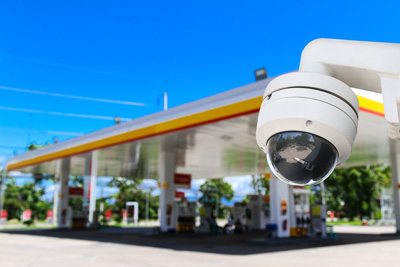 1. Maximize the risk: A well-lit store is a major deterrent to potential criminals. Effective lighting and security cameras are strong indicators—and visual cues to customers—that a store is vigilant about providing a safe environment, both on the lot and inside the store.
It’s also important to minimize signage and decals on windows and doors and use low shelving units to provide clear lines of sight for employees throughout the store and on the lot. Mirrors also can be helpful to help minimize areas where a potential criminal can “hide.”
Minimizing store entrances helps minimize the likelihood that a robber could surprise someone via a different entrance or sneak out the back to escape detection after a robbery. Outside the store, it’s important to also minimize escape routes. In many cases, a fence around the property can help prevent someone from quickly slipping away and instead pushes them to leave via a more visible direction.
Ultimately, criminals want to avoid being detected before they enter a store and want to avoid being seen by someone outside if a robbery is committed. These techniques maximize the risk by increasing the visibility.
2. Minimize the reward: Retailers are less likely to be a target of robbery if the expected haul from a robbery is small. Security experts encourage retailers to minimize cash on hand at stores by using time-release drop safes or other means to limit the amount of money available. These safes cannot be overridden to release cash quickly and potential criminals do not want to risk being caught by waiting for a safe to release funds.
By clearly posting signs that the store has a limited amount of cash on hand and by regularly using a time-release drop safe, retailers minimize the reward for criminals. It’s also important to secure extra inventory that could have a high resale value if stolen. At convenience stores, these items include cigarettes and other tobacco products.
3. Reinforce your security practices with employees: Regularly communicate your security practices to employees, including how to minimize the likelihood of violence, and what information to capture and record if a robbery occurs. Security experts strongly suggest a policy of non-resistance. One study found that violence is 49 times more likely to occur when there is resistance during a robbery. (Source: Victim Injury and Death in Urban Robbery: A Chicago Study, Zimring & Zuehl)
Behaviors of younger and older criminals vary considerably, and they also often have difference reasons for crime. Minimizing the reward and maximizing the risk are the two most effective methods to reduce the risk of robbery, no matter the age of criminal. A study examining the insights of both adult and teenage criminals found that both groups consider two factors as most important when targeting a store: escape routes and the amount of money available. (Source: Teenage Robbers: How and Why they Rob)
There are more than 152,000 convenience stores in the United States. These stores are in every community in the country and account for roughly 14% of the 1.1 million retail locations and restaurants/bars in the country, according to data from NIQ and The NPD Group.
 The U.S. Federal Bureau of Investigation (FBI) tracks crime in its annual Uniform Crime Report (UCR). The UCR reported that robberies increased 1.3% across the U.S. in 2022, with convenience stores and gas stations combined experiencing 13.8% of all robberies.
Overall, most robberies in the United States occur on the street or at home: street muggings account for about 35% of all robberies, and robberies at a residence account for about 16%.
Workplace Fatalities
The 2019 FBI Uniform Crime Report reported that there were 13,874 murders in 2019. Of that total, 509 were associated with a robbery. There is no further classification of where a murder was committed.
The U.S. Department of Labor’s Occupational Safety and Health Administration (OSHA) compiles a “Workplace Violence” overview that provides information on the extent of violence in the workplace, assessing the hazards in different settings and developing workplace violence prevention plans for individual worksites. The report identified 5,250 workplace deaths in 2018 and 40% of these incidents were transportation related. There were 241 fatal incidents for the occupation category “sales and related occupations,” which includes a broad grouping of retail and sales positions. Convenience stores are incorporated within the broad grouping that also incudes several other channels.
Hours of Operation
Convenience stores are open 24 hours to serve people who need convenience items around the clock. These stores are also open during early morning hours so that employees can prepare for the next day. Overall, 65% of convenience stores say they are open 24 hours so that they can restock shelves and replenish inventory. Another 74% say that they prepare food for the morning rush hour and 38% have deliveries that are sometimes easier to quickly unload when the parking lot is less crowded.
That’s not to say there aren’t customers, because shift workers and those traveling longer distances during overnight hours are more likely to visit stores during late-night hours.
Overall, 14% of Americans work a second- or third shift, per the U.S. Bureau of Labor Statistics, and according to the U.S. Department of Labor (PDF), the prevalence of shift work was greatest among workers in service occupations (this is the most recent data available).
Percentage of shift workers by profession:
- 51% of protective service workers (police, fire, EMT, etc.)
- 28% of healthcare support workers (hospital, home care, etc.)
- 29% of transportation workers (truckers, delivery, etc.)
- 40% of those involved with food preparation/related occupations.
Also, a recent NACS retailer member survey found that shift workers are the largest base of customers they serve during overnight hours:
- Shift workers (cited by 95% of convenience stores)
- Police/other protective services (89%)
- Travelers driving long distances (63%)
- Hospital workers/visitors (57%)
- EMT personnel (50%)
- Taxi drivers (48%)
