How Independent C-Store Operators Can Turn Data Into Growth
You’re collecting data—but are you getting the most out of it?
May 26, 2026 | 3 min read
This article is brought to you by Modisoft.
Independent operators spend a lot of time in their business, but that might mean they don’t spend time on their business.
“There’s so much to keep up with on a day-to-day basis,” said Safi Modi, head of growth at Modisoft. “With limited time and lean teams, it’s easy to focus on tracking performance instead of using data to guide smarter decisions.”
According to Modi, there are many areas where operators can dig into data they’re already collecting and turn it into real growth opportunities. “If they use our loyalty program, they’re able to get shopper data in terms of what time of day shoppers are purchasing items,” said Modi. “They can see what items are being bought most frequently and, at a very quick glance, what items are not selling at all.”
Foodservice continues to be a growth opportunity for retailers. Foodservice in total (which includes the five categories of prepared food, commissary, and hot, cold, and frozen dispensed beverages) represents 28.0% of in-store sales, according to preliminary data from the NACS State of the Industry Report® of 2025 Data.
Foodservice’s impact on profitability is even greater, contributing 38.3% of in-store gross profit dollars in 2025. The prepared food category alone would be the No. 1 in-store category in terms of sales dollars generated across all foodservice and in-store merchandise categories, outpacing packaged beverages and cigarettes.
But doing foodservice well—and excelling at the strategic aspect—is a challenge.
In one example, a retailer that worked with Modisoft analyzed its foodservice program, which offered around 30 menu items. “Instead of pulling up the sales page to view what hadn’t sold recently and making an educated guess about what to take off the menu, the business operator put a quick prompt into Sunny, our AI assistant,” said Modi. “He was able to quickly reduce his quantity to 15 items with AI doing a deep dive into the data.” Eliminating the items that might be cutting into margins is “a clear example of the power of analyzing your data to make decisions,” according to Modi.
“This operator could have come to the same conclusions without our AI system, but he didn’t have the luxury of time to really think about his menu and what was working or not.”
A retailer can also draw insights from inventory and sales data to come up with promotions, bundling ideas or cross-merchandising strategies based on sales in complementary categories, Modi said. According to the 2025 NACS Convenience Voices Study, 31.9% of salty snack shoppers and 33.6% of candy shoppers purchased on promotion in the store. “For independents in particular, the best ideas for bundling or cross-merchandising often address local preferences. Their data will guide them, but most need help unlocking the insights in the data,” Modi said.
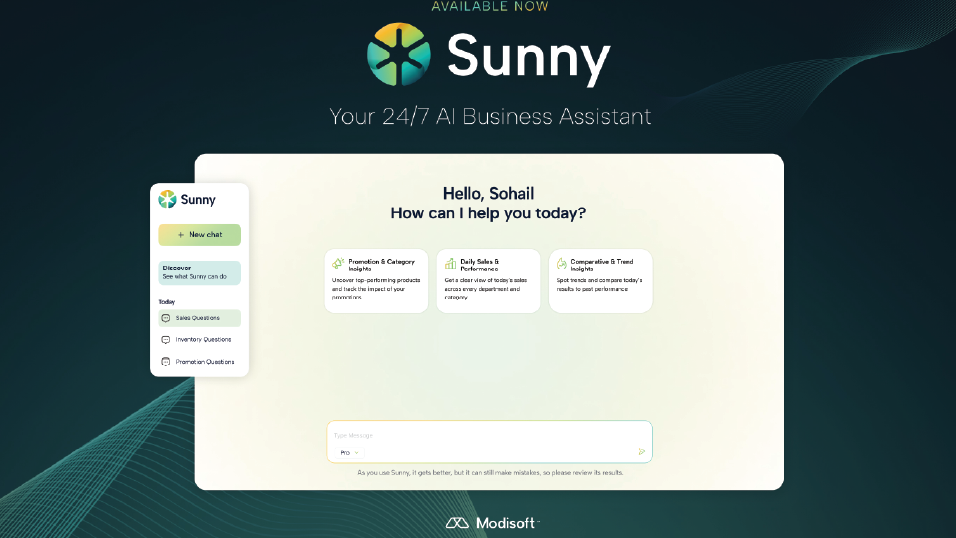
With Modisoft’s platform and its AI-powered Sunny, which acts as a conversational assistant, operators can ask questions about their business and get quick answers, recommendations or insights to help with decision-making.
“Growth doesn’t come from collecting more data, it comes from asking better questions,” said Modi. “It’s about pairing the right metrics and implementing real strategy around the data you already have.”
This is the first in the two-part article series from Modisoft. Look out for part two, which will explore how data can reduce back-office blindspots on Wednesday.
Data management
