Keeping Long Lines From Becoming Lost Sales
Two-thirds of customers report they will leave without making a purchase if a few people are in line.
Mar 30, 2026 | 3 min read
This article is brought to you by Mashgin.
The average convenience store trip is less than four minutes, according to NACS State of the Industry research. Convenience customers value speed, and one thing that can interrupt their experience—and impact their overall satisfaction at a store—is a slow checkout, said Jack Hogan, SVP of partnerships at Mashgin.
“Customers expect convenience stores to be convenient, and that means being able to find what they need and check out in as little time as possible,” he said. “The experience needs to be fast and frictionless. If it’s not, revenue is walking out the door.”
According to data from the company, the average shopper sees three to four people as a long line. On top of that, 64% of people say they would leave a convenience store without making a purchase due to long lines.
“The most important thing about any transaction is that it happens at all. Sixty-four percent of customers will abandon a trip if lines are long. That can become a substantial amount of lost transactions during busy periods of the day,” said Hogan.
The effect is even more pronounced when looking at what Hogan called “high value shoppers,” such as high frequency shoppers, nicotine users and high-income shoppers making over $100,000 annually. These groups are even more sensitive to lines and wait times. They are over 20% more likely to leave a store due to long lines than an average customer. That means nearly 80% of high value shoppers will leave a store with a long line, he explained.
Even more concerning: just two “bad visits” from waiting in long lines would make half of shoppers cross a store off their list forever, according to Mashgin data.
“A great transaction is one that keeps customers coming back—73% of shoppers said they’re more likely to return to a store following a fast and easy checkout experience,” said Hogan. Typically, that means a short wait time and easy accrual or redemption of loyalty points and discounts at the counter. “Locations that offer this experience consistently build long-term preference for customers,” he added.
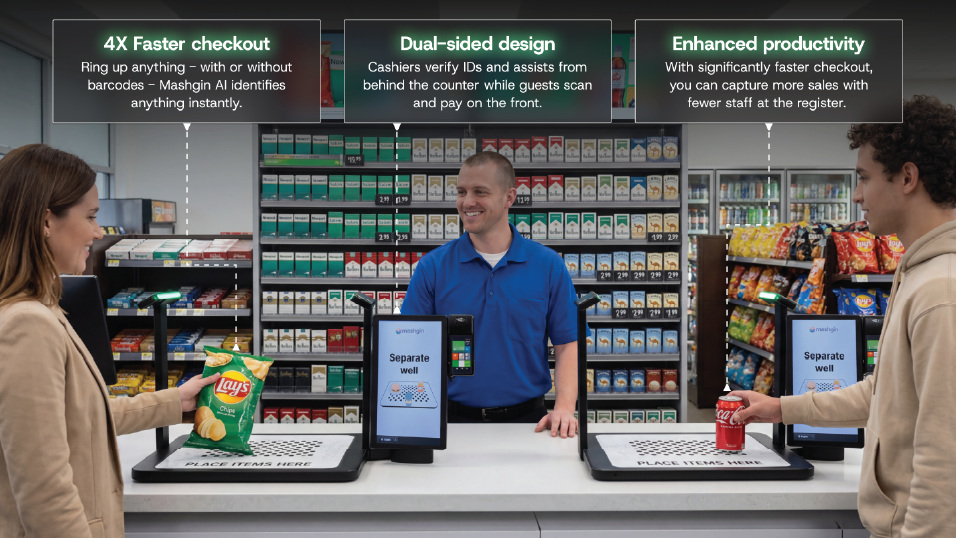
Mashgin reports that most transactions on its AI-powered checkout kiosk take 15 seconds or less, resulting in shorter lines and wait times.
“Mashgin dramatically speeds up transactions and offers a way for customers to check out on their own without losing that speed or doing anything different than they would at a traditional checkout. They just put their items on the counter and are instantly ready to pay,” Hogan said.
Hogan pointed out that an important new development at Mashgin is the launch of its Power Counter, a new form factor for Mashgin’s AI technology that makes it easier for cashiers to utilize the Mashgin as both a primary point of sale or self-service option. The new design keeps counter space open, making it easy for cashiers to help customers and check ID’s for age-restricted purchases, Hogan said.
“Our technology allows the customer to purchase any goods, including gas, lotto and age-restricted items, much faster while still feeling like a human-to-human interaction between the cashier and the shopper,” he said.
This is part one of a two-part series on Mashgin. Look for part two tomorrow to discover how Mashgin increases transaction velocity and labor efficiency.
Artificial Intelligence Checkout Systems
