Boosting Labor Efficiency Through Faster Checkouts
With turnover a challenge, POS tech can increase productivity and reduce employee strain.
Mar 31, 2026 | 4 min read
This article is brought to you by Mashgin.
While the job market fluctuates, one thing is a constant: Turnover remains a challenge for c-store operators.
Most part-time store associates tend to resign within a year, and it requires about 26 applications, 1.4 interviews and 10 days on average to fill a position, according to data from the most recent NACS Talent Insights Dashboard. It then costs several thousand dollars to hire and train hourly associates, and can take over a month from them to become “fully productive.”
“Convenience retailers spend almost $100 billion annually on labor. Now is the time for operators to ensure that their labor is efficient,” said Steven O’Toole, head of convenience and fuel retail business development at Mashgin. “Finding ways to streamline operations, decrease variability and training costs, and make day-to-day work less straining in order to retain employees are key priorities for c-store operators.”
In a tight labor market, frontline employees are often juggling tasks, from manning the cash register to stocking shelves, cleaning and auditing inventory—and sometimes even preparing food. “Stores ask a lot of frontline workers. The more time employees are behind the register, the less time they have to accomplish all of those other tasks we ask of them,” said O’Toole.
According to Mashgin, there are two critical ways retailers can increase their labor efficiency:
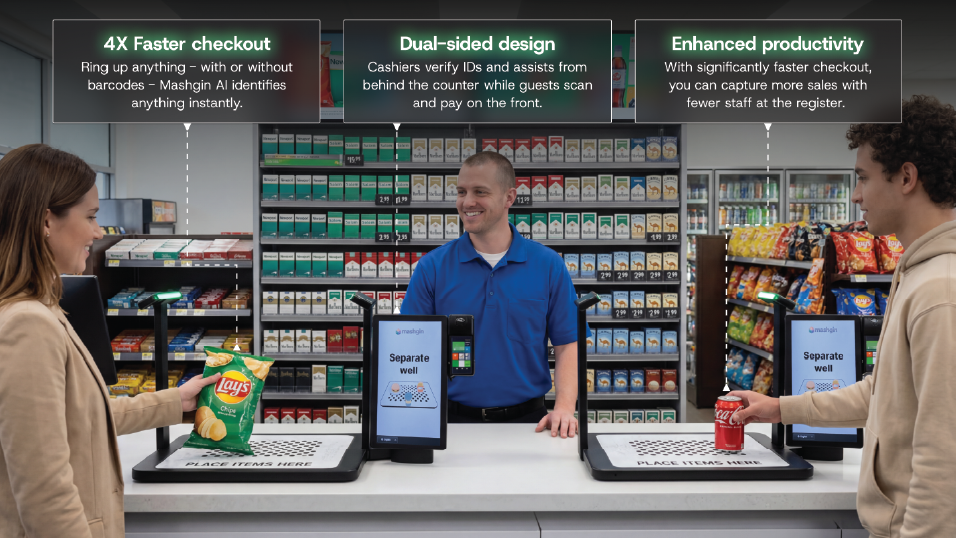
Increasing transaction speed: There are 16.1 customer transactions per labor hour in the average store, according to the NACS State of the Industry Report® of 2024 Data. This translates to about $100.84 in inside sales and $39.26 in inside gross profit dollars per labor hour. The average cashier can complete about 12 transactions in a 15-minute high-volume period, according to Mashgin. “But in stores that had a single Mashgin AI-assisted checkout, the number of transactions increased 150% to 30 transactions per high-volume period. With two Mashgin checkouts, the throughput increased 250% to 42 transactions,” said O’Toole.
An additional concern for operators is that inefficient labor can reduce transactions during peak periods. If a line has more than four people, consumers may abandon the trip. “Our data shows that 64% of people will leave a convenience store without making a purchase due to long lines,” said O’Toole. “Anytime that you have four or more people waiting in line, you risk losing significant revenue, and all of the marketing spend that you’re putting forth to bring people through the door is being wasted if you’re not able to serve them when they come in the store.”
Reducing turnover: “When the checkout process is dramatically more efficient, it allows stores to move employees from checkout to focus on other priorities like hot food prep, restocking shelves or cleaning the store,” said O’Toole. “What you’re really doing is freeing up much more time for employees to be successful in their role.”
“Adding tools that amplify productivity is very impactful for store employees and can help reduce pressure—and therefore turnover. Once cashiers see the value in our technology, they understand that Mashgin helps them deliver a better shopper experience and makes their lives easier. Mashgin is a multiplier of their work, not a competitor,” he said.
According to Mashgin research, 83% of cashiers working in Mashgin-powered stores prefer Mashgin over traditional checkout.
“You also reduce experiences with upset customers that can cause employees to quit. A faster-moving line makes for happier customers, which in turn makes for happier staff,” O’Toole said.
He added that while many new technologies are positioned as human vs. machine, Mashgin is built “to be a value-enhancer of the great work cashiers are already doing. A checkout system that streamlines operations speed can increase productivity and throughput without increasing labor costs.”
This is part two of a two-part series on Mashgin. Read part one, which explored how consumers react to time-consuming checkout experiences, here.
Artificial Intelligence Checkout Systems
