TEI: 6 Strategies for Reducing ICE Emissions
TEI’s latest report offers actionable insights for reducing emissions from internal combustion engine vehicles.
Dec 18, 2025 | 2 min read
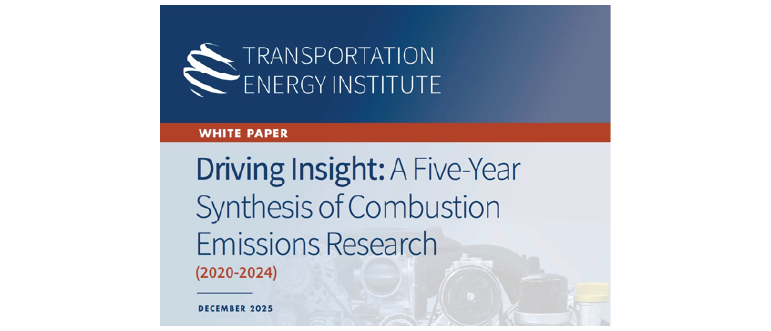
The Transportation Energy Institute (TEI) this week released its latest report, Driving Insight: A Five-Year Synthesis of Combustion Emissions Research, which looked at research from 2020–2024 and found actionable insights for reducing emissions from internal combustion engine vehicles.
The report synthesizes findings from nine major studies, offering a framework for policymakers, industry leaders and stakeholders seeking affordable, scalable and effective emissions reduction strategies.
“TEI has been evaluating options for reducing emissions for years, trying to help the market find solutions that benefit the environment, consumers and industry,” said John Eichberger, executive director of TEI. “Each report incorporated in this paper stands on its own, but together they present a much more comprehensive assessment of what it really takes to develop an effective strategy to reduce emissions and preserve access to affordable and reliable transportation energy.”
The report highlights six critical themes for achieving meaningful emissions reductions:
-
Life Cycle Perspective: Strategies must consider full life cycle emissions for maximum environmental benefit at the lowest cost.
-
Technology Diversity: No single solution fits all; a portfolio approach tailored to specific use cases is essential.
-
Policy Alignment: Government frameworks should align business interests with environmental objectives.
-
Existing Fleet Solutions: Addressing current vehicles is vital; relying solely on new vehicle turnover is slow and inefficient.
-
Scalability and Infrastructure: Solutions must be deployable at scale and account for infrastructure constraints.
-
Affordability: Economic feasibility and total cost of ownership are fundamental to success.
The full report can be accessed here.
